

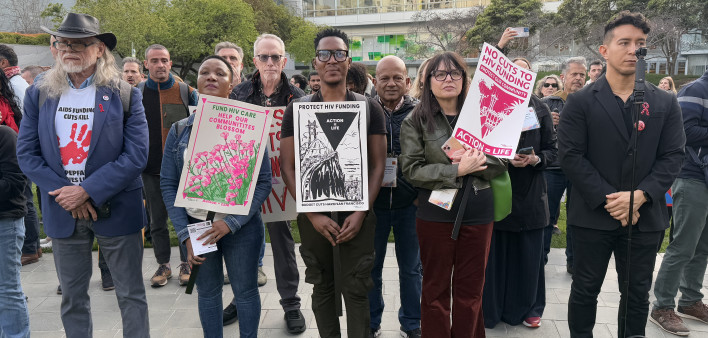
Several hundred researchers, clinicians, advocates and people living with HIV gathered Monday, March 10, to “Save Our Sciences” in the face of the Trump administration’s cuts to research and health services in the United States and around the world. The rally, organized by the San Francisco AIDS Foundation’s HIV Advocacy Network, coincided with the annual Conference on Retroviruses and Opportunistic Infections (CROI 2025), taking place this week in San Francisco.
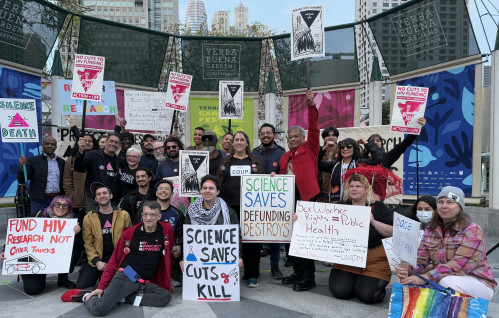
HIV Action Network at CROI Save Our Sciences rally, March 10, 2025Liz Highleyman
“We are here today because the stakes are too high to be silent, because of the attacks on our very lives—the lives of Black and brown people, of trans people, of the communities that have borne the brunt of the epidemic for far too long,” said San Francisco AIDS Foundation CEO Tyler TerMeer, PhD. “HIV research has transformed what it means to live with the virus. It has given us treatment that allows people like me to not only live and survive but to thrive. It has led us to PrEP, to U=U, to new prevention tools that protect the most vulnerable among us. If we let this administration put politics before science, we risk halting progress that could bring us closer to a cure, to a vaccine, to a future where no one has to fear this virus ever again. We did not come this far to be silenced. We did not fight through decades of stigma, of discrimination, of government indifference to watch history repeat itself.”
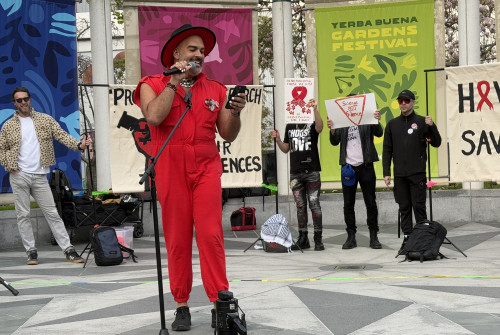
SF AIDS Foundation CEO Tyler TerMeer at CROI Save Our Sciences rally, March 10, 2025Liz HIghleyman
As previously reported, President Donald Trump has withdrawn the United States from the World Health Organization and cut funding for USAID, the main funder of PEPFAR (the President’s Emergency Plan for AIDS Relief). The administration proposes to dramatically reduce grants from the National Institutes of Health (NIH), the world’s largest funder of medical research. Republican legislators have put forth a budget that slashes Medicaid, which covers some 40% of people living with HIV. What’s more, following Trump’s executive orders against “gender ideology” and “DEI” (diversity, equity and inclusion), the administration has censored information and aims to halt programs that support transgender people and other key populations disproportionately affected by HIV.
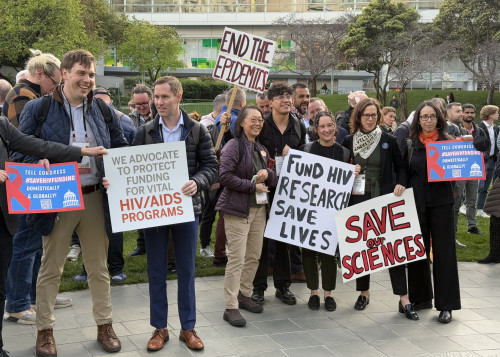
CROI Save Our Sciences rally, March 10, 2025Liz Highleyman
“We recognize that this year’s meeting is taking place in a time of tremendous apprehension and uncertainty as a result of recent actions by the U.S. government,” the CROI Foundation and program committee said in a media statement. “[I]n times like this, it is more crucial than ever for the scientific and advocacy communities to come together to support research and forge a path that enhances the lives of people around the world.”
HIV research not only benefits people living with HIV, but the basic science has led to a better understanding of the immune system and laid the groundwork for advances in vaccines, cancer immunotherapy, gene therapy and much more. COVID vaccines, for example, were developed in record time thanks in part to the work of researchers at the NIH Vaccine Research Center.
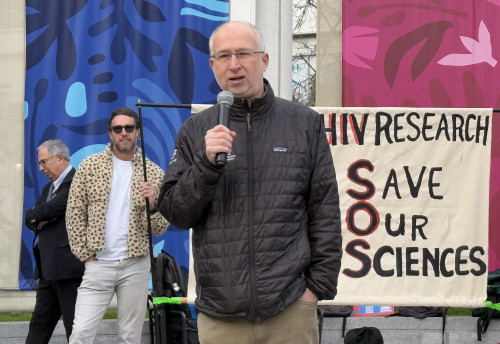
Steven Deeks at CROI Save Our Sciences rally, March 10, 2025Liz Highleyman
“I’ve been involved in HIV research since 1993 and NIH has been very generous to us. We collectively have received billions of dollars over the decades, and everybody in the United States who contributed as taxpayers to NIH needs to know that the return on the investment goes well beyond HIV,” said Steven Deeks, MD, of the University of California San Francisco. “In the early days, when the HIV research agenda was getting going, the leaders at NIH at first were taken aback by ACT UP and all the activists but eventually brought them in. All the stakeholders, including the community activists, sat down and formulated this plan that we continue to follow. Having community deeply engaged in a real, sustained manner is something that was an HIV thing first and is now basically taken for granted.”
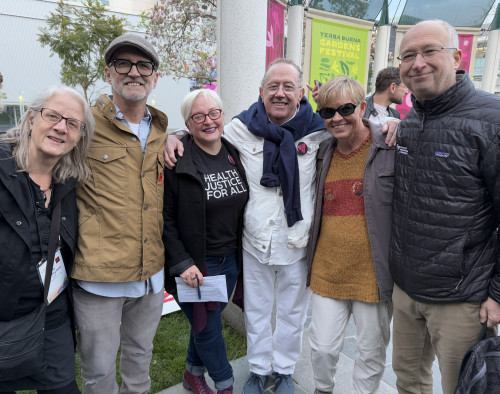
Save Our Sciences rally, March 10, 2025Liz Highleyman
“We spent the first 10 years of the AIDS pandemic fighting with some of the researchers that we’ve been working so closely with over the last 35 years,” recalled Treatment Action Group executive director Mark Harrington. “In the early days, we had to fight for the right to be studied. We had to fight for the right of women to be studied, of infants, of young children, of IV drug users, of people with hepatitis, people with tuberculosis, people that didn’t have housing, people that came from other countries. Everyone has a right, not just to health but to science. There’s so much science that needs to be done to help support the trans community. The same is true of people of color, immigrants, prisoners and many other groups.”
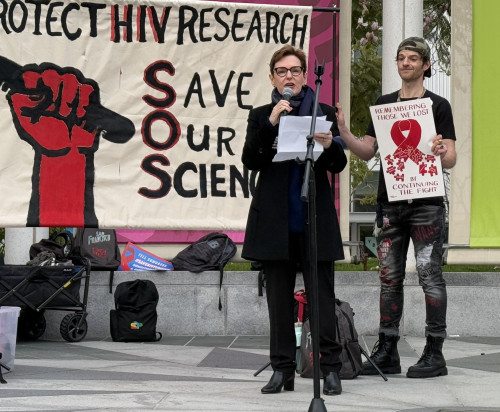
IAS President Beatriz Grinsztejn at CROI Save Our Sciences rally, March 10, 2025Liz Highleyman
International AIDS Society president Beatriz Grinsztejn, MD, PhD, worries that the prevention breakthrough many have dreamed of—twice-yearly lenacapavir PrEP—may not be realized without continued funding, as 90% of all PrEP used globally is provided through PEPFAR. She’s also concerned about not investing in the next generation of HIV researchers. “In just a few weeks, the science and research ecosystem has been shaken to its core,” she said. “My big fear is that sometime in a not-too-distant future, we will face a sharp resurgence of HIV, increased HIV-related deaths and resistance to lifesaving antiretrovirals and TB drugs. We must not allow this to happen.”
The final speaker, Naina Khanna, founding executive director of Positive Women’s Network–USA, noted that the rally took place on National Women and Girls HIV/AIDS Awareness Day.
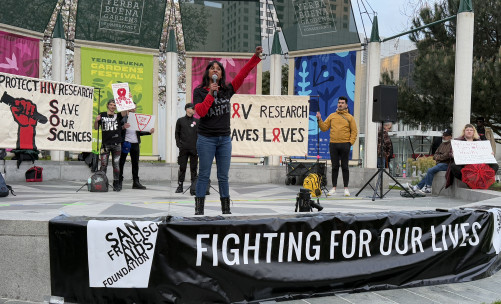
Naina Khanna of Positive Women’s Network USA at CROI Save Our Sciences rally, March 10, 2025Liz Highleyman
“I would not be here—and many other women and girls, including trans and cis women and girls around the world—would not be here today without the infrastructure that has been developed and supported by so many advocates and researchers and scientists who are right here,” she said.
“I want to break apart this distinction we keep making between activists and researchers and scientists,” she continued. “We all have to be activists. We’re all here to fight for justice. We’re here to fight for services. We’re here to fight for equity and rights, and we understand exactly who we are fighting for.”
Click here for more news from CROI 2025.


Comments
Comments